We are pleased to share the extensive interview that Emily Price (Forbes) dedicated to Cristina Mariani-May, CEO and President of Banfi, a story that addresses the most topical issues for the future of Brunello di Montalcino: climate change, the evolution of wine style, scientific research, sustainability and the value of terroir.
In the interview, Cristina offers a sincere and direct view of the work we do every day, highlighting our company's commitment to preserving the authenticity, elegance and identity of Sangiovese.
There is no longer a typical grape harvest
Cristina describes the last ten years as a period in which predictability has disappeared, taking the 2024 grape harvest as an example:
Faced with these conditions, our work in the vineyard is based on a micro-viticultural approach, which Cristina explains as follows:
"We manage each plot, and sometimes each individual row, according to its characteristics. With 29 soil types and more than 100 microclimates, precision is everything. This allows us to maintain healthy grapes, ripe tannins and a balanced alcohol profile, even in complex vintages."
Wood and Sangiovese: a philosophy of balance
Cristina clarifies our approach to ageing Brunello:
"Wood must accompany, not cover. After decades of comparative tastings, we still prefer large barrels: they preserve the identity of Sangiovese and respect the character of Montalcino."
He adds:
"For us, wood is the home where Brunello rests and becomes gentler and more elegant. But it must never become an ingredient."
Wood and Sangiovese: a philosophy of balance
Cristina clarifies our approach to ageing Brunello:
"Wood must accompany, not cover. After decades of comparative tastings, we still prefer large barrels: they preserve the identity of Sangiovese and respect the character of Montalcino."
He adds:
"For us, wood is the home where Brunello rests and becomes gentler and more elegant. But it must never become an ingredient."
Elegance as a future direction
Cristina notes that the contemporary sensibility towards fresher, more balanced wines represents a return to the original style of Brunello:
"Today, elegance and authenticity are finally recognised as values. For us, this is not a trend: it is the confirmation of our philosophy."
It also mentions the cultural contribution of the project Sanguis Jovisthe first study centre dedicated exclusively to Sangiovese.
A terroir that tells millions of years of history
One of the most evocative moments of the interview concerns the discovery of the fossil whale 'Brunella'found in 2007 near the Castle of Poggio alle Mura.
Cristina recounts:
"That discovery changed the way we look at soils forever. Montalcino is literally rich in Pliocene marine fossils: shells, microfossils, sediments. It is an ancient past that continues to speak in our vineyards."
Adapting to preserve Brunello
Looking ahead to the coming years, Cristina explains how we deal with climate change:
"We are rethinking planting density, canopy management and the use of cooler soils. Our aim is to maintain consistency and identity, adapting to the variability of the climate without distorting Brunello."
Our estate, with 2,900 hectares between vineyards, olive groves, arable land and natural areas, plays a key role in protecting biodiversity.
Welcoming the world to Montalcino
Finally, Cristina recalls the value of hospitality:
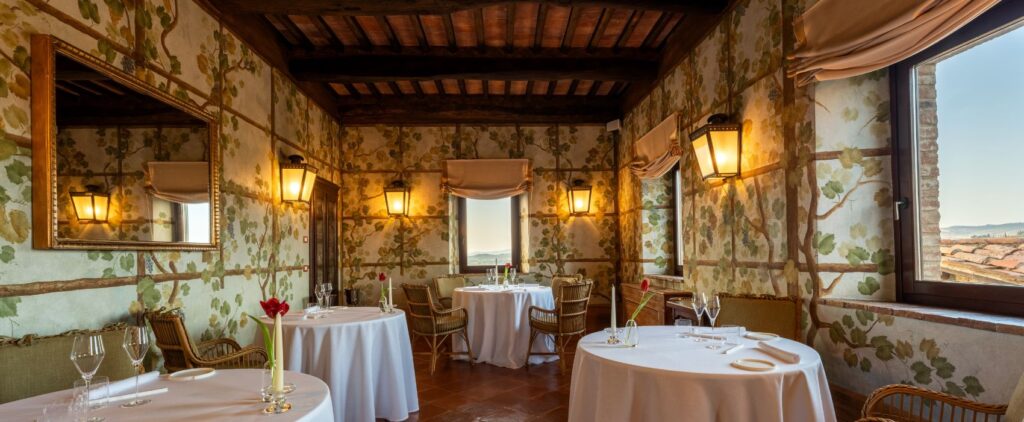
"Every year we welcome around 40,000 visitors. Through tastings, the Enoteca, Il Borgo and our Sala dei Grappoli, awarded a Michelin Star for the sixth year running, we tell our story to people from all over the world."
Our vision
The interview highlights the essence of our work:
preserving the Brunello tradition through research, sustainability, culture and territorial awareness.
A vision that continues to guide our every choice, today and in the future.